
Residential Conveyancing Basics · · 12 min read · By Blog Team
What Is Residential Conveyancing? A Beginner's Guide
A plain-English introduction to what residential conveyancing actually involves, from who does the legal work to the key stages, terms, costs and timelines you'll encounter buying or selling a home.
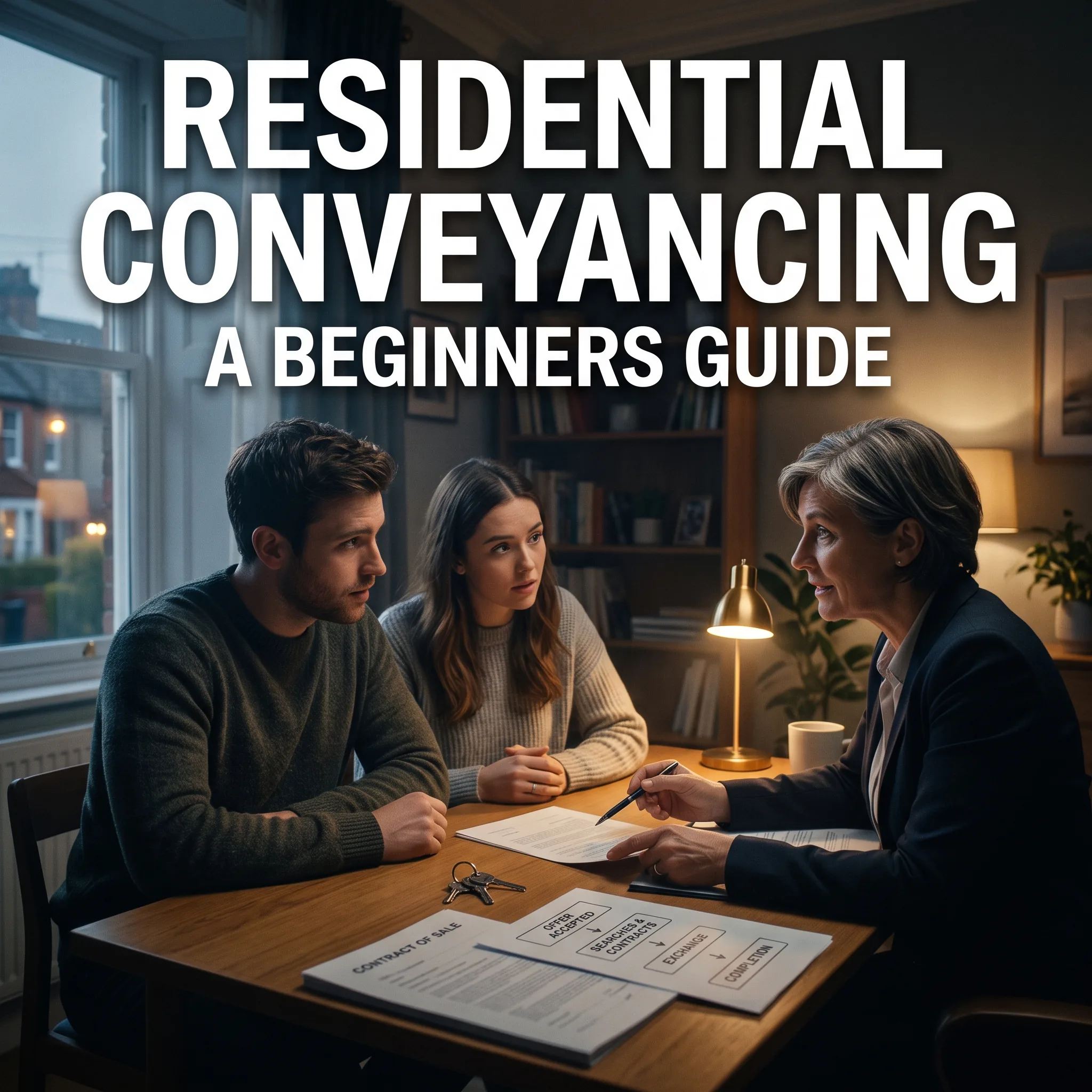
Residential conveyancing is the legal and administrative process of transferring ownership of a home from one person to another, and it covers everything from checking who really owns the property to registering you as the new legal owner once the money has changed hands. It typically involves a solicitor or licensed conveyancer on each side, a set of property searches, a contract, and two key dates known as exchange and completion. If you've never bought or sold a house before, that probably sounds like a lot, so this guide breaks it down piece by piece.
Most people encounter the word "conveyancing" for the first time when an estate agent mentions it, or when a solicitor's quote lands in their inbox with a list of fees that means nothing to them yet. It's one of those terms that gets thrown around constantly in the property world while almost nobody stops to explain what it actually involves. Which is a shame, because understanding the basics makes the whole home-buying experience considerably less stressful.
Before we go further, a quick note on who's writing this. I'm a blogger covering the property and conveyancing world, not a solicitor and not a licensed conveyancer. Everything here is general information to help you understand the process, not legal advice tailored to your situation. If you want guidance on your own purchase or sale, that conversation needs to happen with a qualified professional who can actually look at your paperwork.
With that out of the way, let's get into what residential conveyancing actually is, why it exists, and what you can expect if you're going through it for the first time.
Table of contents
- What is residential conveyancing, exactly?
- Why the legal process exists at all
- Who actually does the conveyancing work
- The main stages of a conveyancing transaction
- Key terms you'll keep hearing
- What conveyancing costs and how long it takes
- How conveyancing differs for buyers and sellers
- Getting started with your own conveyancing
- FAQs about residential conveyancing
- Summary and what to do next
What is residential conveyancing, exactly?
At its simplest, conveyancing is the legal work required to move a property from one owner to another. That sounds straightforward, and conceptually it is, but in practice it involves quite a lot of checking, verifying, and paperwork before anyone actually hands over a set of keys.
When you buy a house, you're not just paying money for bricks and mortar. You're acquiring a legal title to that land and everything attached to it. Your conveyancer's job is to make sure that title is genuine, that the seller actually has the right to sell it, and that there's nothing lurking in the background that could cause you problems down the line, things like unresolved boundary disputes, unpaid charges secured against the property, or restrictions on how the land can be used.
The word itself
"Conveyance" is an old legal term meaning to transfer or carry something. In property law, it refers to the transfer of ownership. "Conveyancing" is just the process of doing that transfer properly, with all the checks and legal formalities that go alongside it. It's not a modern invention either. The underlying idea of formally transferring land ownership goes back centuries in English law, even though the specific documents and systems used today, particularly Land Registry records, are much more recent.
It's not just for buyers
People often assume conveyancing is something only buyers deal with, but sellers go through it too. If you're selling, your conveyancer prepares the paperwork that proves your ownership and answers the buyer's questions about the property. Buying and selling conveyancing run in parallel, especially if you're doing both at once, which is normal for anyone moving up (or down) the property ladder rather than buying their very first home.
Why the legal process exists at all
It would be lovely if buying a house were as simple as agreeing a price and shaking hands. Unfortunately property is complicated, expensive, and permanent in a way that most other purchases aren't. If something goes wrong with a car you bought, you can usually sell it or scrap it. If something goes wrong with a house, you're often stuck with the consequences for years, sometimes for as long as you own it.
The legal process exists to catch problems before they become your problem. Here's what it's protecting you against, roughly:
- Buying a property that the seller doesn't actually have full legal right to sell
- Inheriting debts or charges secured against the property by a previous owner
- Discovering after completion that there are restrictions on what you can do with the land
- Boundary disputes with neighbours that nobody flagged beforehand
- Planning issues, like an extension built without the right permissions
- Environmental or flood risks that weren't obvious from a viewing
None of that is likely to happen on any given purchase, honestly, most transactions are fairly routine. But the checks exist precisely because property is high value and hard to undo, so it's worth getting right the first time.
Who actually does the conveyancing work
Conveyancing can be carried out by two types of professional in England and Wales: a solicitor or a licensed conveyancer. Both are qualified to handle property transactions, though they've come to it through different training routes.
Solicitors vs licensed conveyancers
A solicitor is a fully qualified lawyer who can practise across various areas of law, though many specialise in property. A licensed conveyancer, by contrast, has trained specifically in property law and transactions and is regulated by the Council for Licensed Conveyancers. Both are regulated professionals, both carry professional indemnity insurance, and both are entirely capable of handling a standard residential purchase or sale. Neither option is inherently "better", it tends to come down to the individual firm's experience, communication style, and fees.
Other people you'll come across
- Estate agents, who usually act for the seller and help coordinate the chain
- Mortgage lenders and their own solicitors, who have their own legal requirements to satisfy
- Surveyors, who check the physical condition of the property rather than the legal side
- Land Registry, the government body that formally records ownership
- Local authorities, who respond to search enquiries about planning and other matters affecting the property
It can feel like a lot of moving parts for what seems, on paper, like a fairly simple transaction. That's largely because it is a lot of moving parts, and part of your conveyancer's job is to keep track of all of them so you don't have to.
The main stages of a conveyancing transaction
Every transaction has its quirks, but most residential conveyancing follows a broadly similar path from start to finish.
The typical order of events
- Instruction: you appoint a solicitor or licensed conveyancer, usually as soon as your offer is accepted (or you accept one, if you're selling)
- ID and funds checks: your conveyancer verifies your identity and the source of your money, as required by anti-money-laundering regulations
- Draft contract and paperwork: if you're buying, the seller's solicitor sends over a draft contract along with the title documents and property information forms
- Searches: your conveyancer orders local authority, water and drainage, and environmental searches, among others depending on the property
- Enquiries: your conveyancer raises questions about anything unclear or concerning in the paperwork
- Mortgage offer: if you're borrowing, your lender issues a formal offer once its own checks are complete
- Reports and signing: your conveyancer explains the contract and the findings, and you sign the contract ready for exchange
- Exchange of contracts: both sides exchange signed contracts, and the transaction becomes legally binding
- Completion: the money is transferred, ownership legally passes, and you get the keys
- Post-completion: your conveyancer pays any Stamp Duty Land Tax due and registers your ownership with Land Registry
That's a simplified version, and chains, leasehold properties, or unusual mortgage conditions can all add extra steps. But broadly, that's the shape of a standard purchase or sale.
Exchange and completion aren't the same thing
This trips a lot of first-timers up, so it's worth flagging early. Exchange of contracts is the point where the deal becomes legally binding, both sides are committed, and pulling out afterwards has serious financial consequences. Completion is the day the money actually moves and you get your keys. Sometimes these happen on the same day. More often there's a gap of a week or two between them, agreed by both sides in advance.
Key terms you'll keep hearing
Conveyancing comes with its own vocabulary, and getting familiar with a handful of terms early on makes the whole process feel much less foreign.
- Title: the legal right of ownership to a property, recorded at Land Registry
- Freehold: you own the property and the land it sits on outright, with no time limit
- Leasehold: you own the right to occupy the property for a fixed number of years, while someone else (the freeholder) owns the underlying land
- Searches: enquiries made to local authorities and other bodies to reveal issues affecting the property
- Completion statement: a breakdown of exactly what money is being paid and received on completion day
- Disbursements: third-party costs paid on your behalf, such as search fees or Land Registry fees
- Stamp Duty Land Tax (or Land Transaction Tax in Wales): the tax due on property purchases above certain thresholds
Why the terminology matters
You don't need to become an expert overnight, but recognising these terms means you'll actually understand your conveyancer's updates rather than nodding along and hoping for the best. It also makes it much easier to ask sensible questions when something in your case doesn't quite make sense to you.
What conveyancing costs and how long it takes
This is usually the first question people ask, and fair enough. Costs and timescales vary a fair bit depending on the property, whether there's a chain, and whether you're buying with a mortgage.
Typical costs
Conveyancing fees generally include the conveyancer's own legal fee plus a set of disbursements, third-party costs paid on your behalf. These commonly include:
- Search fees (local authority, water and drainage, environmental)
- Land Registry registration fees
- Bank transfer fees for moving completion funds
- Stamp Duty Land Tax, if applicable, based on the purchase price and your circumstances
- Leasehold-specific fees, such as notice of transfer or management pack costs, if the property is leasehold
Quotes vary between firms, so it's worth asking for a clear, itemised breakdown before you instruct anyone, rather than judging purely on the headline figure.
Typical timescales
A straightforward purchase or sale with no chain and a mortgage in place might complete in roughly eight to twelve weeks from offer acceptance to keys in hand. Add a chain, a leasehold property, or something unusual in the searches, and it can stretch out considerably longer. There's no universal answer here, and anyone who promises you an exact timeline on day one is guessing, because so much depends on other people in the chain moving at the same pace as you.
How conveyancing differs for buyers and sellers
Although the overall process runs in parallel, the actual work looks a bit different depending on which side of the transaction you're on.
If you're buying
Your conveyancer focuses on protecting your interests. That means reviewing the title, raising enquiries about anything unclear, ordering searches, checking the mortgage offer conditions, and eventually registering you as the new owner. A lot of the early legwork sits with the buyer's side, since you're the one who needs reassurance before committing.
If you're selling
Your conveyancer's job is largely about supplying information rather than digging for it. They'll prepare a draft contract, gather title documents, answer the buyer's enquiries, and liaise with your estate agent and any lender if you have a mortgage to redeem. Sellers often find their side of the process feels a bit quieter in the middle stretch, simply because you're waiting on the buyer's side to complete its checks.
Doing both at once
If you're selling one property and buying another simultaneously, which is the norm for most home movers, your conveyancer will be managing both transactions together, trying to line up exchange and completion dates so you're not left homeless for a week or paying for two properties at once. This is where chains add real complexity, since your dates depend on everyone else's dates too.
Getting started with your own conveyancing
If you're at the beginning of this process, here's a sensible order of operations.
- Get quotes from a few solicitors or licensed conveyancers before your offer is even accepted, so you're not scrambling once things move fast
- Ask what's included in the quote and what counts as an extra, leasehold properties in particular often carry additional charges
- Have your proof of ID and proof of funds ready in advance, since your conveyancer will need these early on
- Respond to requests promptly, delays on your end can hold up the whole chain
- Ask questions whenever something isn't clear, a good conveyancer would rather explain something twice than have you sign blind
None of this needs to be complicated. It's mostly a case of being organised, responsive, and willing to ask "what does that actually mean?" whenever you're unsure.
FAQs about residential conveyancing
Do I legally need a solicitor or conveyancer to buy a house in England or Wales?
Yes, in practice you do. Lenders require a solicitor or licensed conveyancer to act in any mortgage-funded purchase, and even cash buyers would be taking on considerable risk trying to handle the legal transfer themselves.
What's the difference between a solicitor and a licensed conveyancer?
Both can carry out conveyancing work and are regulated professionals. A solicitor is a general lawyer, often specialising in property, while a licensed conveyancer has trained specifically in property transactions. Either can handle a standard residential purchase or sale competently.
How long does residential conveyancing usually take?
A simple transaction without a chain might take around eight to twelve weeks. Chains, leasehold properties, or complications found during searches can extend that considerably, sometimes to several months.
Can I pull out of a purchase before exchange of contracts?
Generally yes, before exchange either side can withdraw without major legal or financial penalty, though you may lose money already spent on searches, surveys, or valuation fees.
What happens if something concerning turns up in the searches?
Your conveyancer will raise it with the seller's side as an enquiry, and depending on the issue, it might be resolved with more information, a price adjustment, or in rare cases lead you to reconsider the purchase entirely.
Do I need a survey as well as conveyancing?
Yes, they cover different things. Conveyancing deals with the legal side of ownership, while a survey assesses the physical condition of the building. Most buyers arrange both, often through different professionals.
Summary and what to do next
- Residential conveyancing is the legal process of transferring property ownership from one person to another
- It's carried out by a solicitor or licensed conveyancer, and involves searches, contracts, exchange, and completion
- Exchange makes the deal legally binding, completion is when the money moves and you get the keys
- Costs include a legal fee plus disbursements such as searches and Land Registry fees
- Timescales vary widely, but eight to twelve weeks is a reasonable starting expectation for a chain-free purchase
- Buyers and sellers each have distinct roles in the process, even though the transactions run in parallel
As I mentioned earlier, I'm writing this as someone who covers the property world as a blogger, not as a solicitor or licensed conveyancer, so please treat this as background reading rather than advice about your own transaction. Every purchase and sale has its own particular details, and those are best discussed with a qualified professional who can look at your specific paperwork.
Need help or have questions?
I can't give you legal advice on your own situation, that's simply not my place as a blogger rather than a qualified professional. What I can do is point you towards other guides on this site that dig into specific parts of the process in more detail, whether that's searches, leasehold quirks, or what to expect at completion.
If you've got a question you'd like to put to a real conveyancing team, our contact form is the quickest way to reach us. Just send your question through and we'll get back to you.
This article is written from a blogger's perspective for general information only, not by a solicitor or licensed conveyancer, and it isn't a substitute for personalised legal advice. Please speak to a qualified solicitor or licensed conveyancer about your own purchase or sale.
This article is for general information only and does not constitute legal advice. While we aim to keep the content accurate and up to date, errors may occur. If you need clarity or support with your conveyancing, Fast Residential Conveyancing is here to help you understand your next steps.